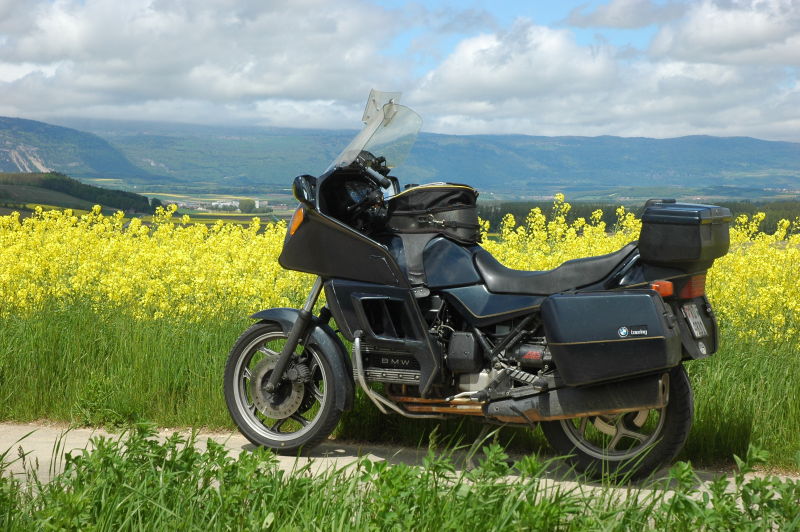


This page is about my BMW K100LC. I ride this bike since summer 2010, it is still in my possession - and I do not think of selling it ;-)
Following the initial presentation of the K series in late 1983, BMW introduced the K100RT already in 1984, in parallel to the K100RS. The RT was produced until 1988, then officially superseded by the K100LT that had been introduced as a "luxury version" in 1986 and that was available until 1991.
According to its VIN, my particular K100LT was produced in 1989-10 and first put into circulation on 1990-05, exactly the same month like my trusty R80GS. I bought it from a Harley-Davidson rider who had owned the LT for 18 years in a row and said he used it "only when the Harley had a breakdown". Looking at the 8-year old tires on the LT, it would appear that HD have become quite reliable ;-)
The engine characteristics of the K series is completely different to that of the 2V boxer. The boxer is a spontaneous, jumpy engine; the K is somewhat sluggier (I'd compare it to a TDi car engine ;-), but at the same time also incredibly smooth - without the gear indicator, I would frequently look for a 6th gear on the highway, or try to take hairpins in 3th. In addition, gas consumption is not excessive: Around 6 l/100 km on the highway and about 5.0...5.5 l/100 km on secondary roads, giving a range of 275 to 320 km before the reserve light comes on. After that, there are about 50 km of reserve but with a 285-kg bike you do not want to try this ;-). Overall, about 19.9 l of the nominal 22 l in the gas tank are actually usable before the engine starts to sputter.
The well-designed fairing, the storage space, the smooth engine and the moderate gas consumption make the bike very convenient for long-distance riding. Indeed the K100LT replaces my R100TIC.
The "old" airhead RT carries about 40 kg less than the LT and has a very low center of gravity, providing superior handling on secondary roads and in city traffic. Together with the bigger wheels (19" front is standard in today's "Enduro" bikes!) and the long suspension travel, the airhead RT allows to go pretty fast on roads with a bumpy, deteriorated surface. On the downside, the frame and fork are rather weak and the brakes may require "planning ahead". It's a perfect bike for long rides on country roads, no matter what surface.
On the other hand, the LT offers a superior frame, brakes and suspension, with the associated stability at any speed. The LT feels rather top-heavy and at low speeds the bike has a tendency to "drop" into a curve, but once you get used to this it is rather easy to handle. Add to this the low seating position; even small riders can easily place both feet on the ground. The brakes (ABS!) are appropriate and easily deal with the half-ton weight of the fully loaded bike. On the downside, the reduced suspension travel of the LT is noticeable on bumpy roads, where overall riding comfort degrades with the degradation of the road surface. Personally, I qualify the LT as a comfortable "mile muncher" and commuter bike, preferably to be used on roads with a relatively good surface - and perfectly at ease on today's highways, which were by far not the strength of the airhead RT.
The table below gives a short comparison of a few technical data to its predecessor, both historically and in my garage. Note that in particular the engine data refer to the Swiss version, which has less power and torque than the stock version (due to a different ignition control module, different exhaust system, bigger valve pockets on the pistons and 284/96 camshafts for inlet and exhaust).
| K100LT 1990 | R100TIC 1981 | |
|---|---|---|
| Engine | 4 cylinder in line, DOHC, liquid cooled | 2 cylinder boxer, OHV, air cooled |
| Displacement | 67×70 mm, 987 ccm | 94×70.6 mm, 980 ccm |
| Power | 58 kW (79 HP) at 6800/min | 49 kW (67 HP) at 7000/min |
| Torque | 83 Nm at 4000/min | 72 Nm at 5500/min |
| Compression ratio | 10.2:1 | 8.2:1 |
| Gas Tank and Consumption | 22 l, ca. 5.7 l/100 km | ca. 22 l, 6.0 l/100 km |
| Gross weight | 283 kg | 245 kg |
| Max weight | 480 kg | 440 kg |
| Wheelbase | 1516 mm | 1465 mm |
| Front wheel | 100/90-V18 or 110/80-V18 on 2.50×18 MT H2 | 3.25H19 on 2.15B19 |
| Rear wheel | 130/90-V17 or 140/80-V17 on 2.75×17 MT H2 | 4.00H18 on 2.50B18 |
| Front Brake | Double disk, 285 mm, ABS | Double disk, 260 mm |
| Rear Brake | Single disk, 285 mm, ABS | Simplex drum, 200 mm |
| Front Suspension | Telescopic fork, d=41.4 mm, 185 mm suspension travel | Telescopic fork, d=36 mm, 200 mm suspension travel |
| Rear Suspension | Monolever, 110 mm suspension travel | Twin shock, 125 mm suspension travel |
| Ground clearance | 175 mm | 165 mm |
| Alternator | 460 W | 280 W |
When I acquired the LT, the bike was equipped with Metzeler ME330 100/90-18 56V on the front and ME550 140/80-VB17 69V on the rear wheel. Their DOT number indicated that both tires are already a few years old (2002 - I acquired this bike in 2010!), so I rode them carefully for a while during summer, then changed for Bridgestone BT45 (110/80-18 58V @ 2.6 bar, 140/80-17 69V @ 3.0 bar).
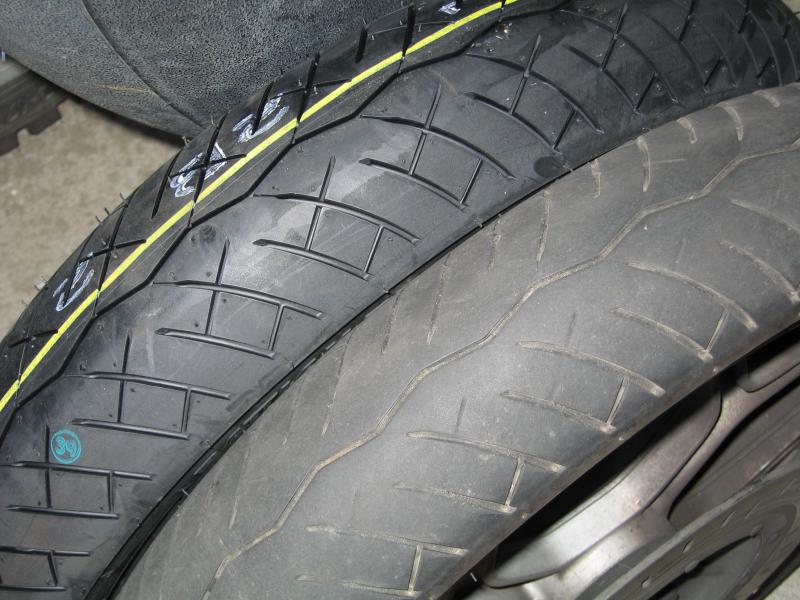 The BT45 provides perfect handling and sticks nicely to the tarmac, also on wet roads. On the downside, the first rear tire lasted barely
4600 km so that I needed to change a tire during holidays in southern France. It should be noted that this tire exists in two different
versions, the 140/80-17 and 140/80-B17 - the "B" version lasts longer but many tire dealers seem to ignore its existence
(which is the reason why I "had to" get a standard 140/80-17 in the first place). Currently, I'm getting about 6600 km out of a "B" tire, which is 50% better than the "non-B" tire but still not much.
The BT45 provides perfect handling and sticks nicely to the tarmac, also on wet roads. On the downside, the first rear tire lasted barely
4600 km so that I needed to change a tire during holidays in southern France. It should be noted that this tire exists in two different
versions, the 140/80-17 and 140/80-B17 - the "B" version lasts longer but many tire dealers seem to ignore its existence
(which is the reason why I "had to" get a standard 140/80-17 in the first place). Currently, I'm getting about 6600 km out of a "B" tire, which is 50% better than the "non-B" tire but still not much.
On the front wheel, the BT45 Front lasts about 7500 km before the profile approaches the legal limits. The tire wears out in a rather asymmetric pattern: while both the center and the outer side are at 2.7 mm (new: 4.6 mm and 3.5 mm, respectively), it is the shoulder that is down to 2.0 mm (new: 4.1 mm) and that marks the zone of highest wear.
When I bought the LT it was equipped with the stock BMW shock, which soon turned out to be completely "shot": The rear suspension bottomed out on any larger bump such as a train crossing. I could soon acquire a second-hand WP shock from a K100RS and installed it; the bike's behaviour was much better now ... but it still bottomed out when riding 2-up.
I had the impression that the spring was too weak (45 N/mm) since I could not even adjust the correct static sag. Thus I decided to have this WP shock revised ... and it turned out that it was worn out beyond repair (economically speaking). Glad I had not paid too much for that unit ;-)
I immediately ordered a brandnew, custom-made Wilbers 530 shock with spring 55-270, received and installed in 2011-06. At the same time, I swapped the stock fork springs against progressive springs, also from Wilbers. Riding behaviour with the Wilbers suspension is much better - but you would expect that when swapping a worn-out part against a brand-new shock, no?
Something that I cannot recommend, however, is the longer version of the shock that is offered by Wilbers: I have the impression that the bike became slightly more nervous in fast corners. In addition - and this is the really annoying part - the long shock rises the rear end of the bike significantly: The bike leans much more on the sidestand and it requires quite some force to put it vertically. My recommendation is to stick with the standard length!
The next suspension upgrade came in 2020-05 when I had the opportunity to acquire a Boge Nivomat shock in good shape. This shock adjusts its preload and damping behavior dynamically while riding, depending on the load and on the road surface. This is actually the best possible approach for my purpose, since I frequently change between 1-up and 2-up riding. This shock has exceeded my expectations :-)
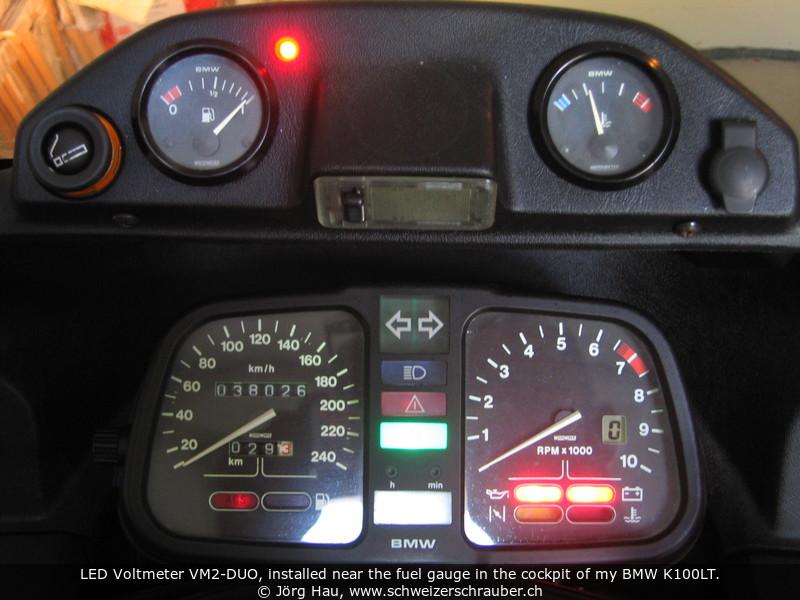 The instruments of the K series are rather complete, providing e.g. a gear indicator (useful since I keep looking for a higher gear ;-),
and a speedometer with astonishing accuracy (less than 2% error, compared to a GPSr).
In addition, the LT features a rather complete set of instruments: Besides the usual set, you get a fuel gauge and one for the coolant temperature
(highly useful, since it can warn you early enough about fan failure).
The instruments of the K series are rather complete, providing e.g. a gear indicator (useful since I keep looking for a higher gear ;-),
and a speedometer with astonishing accuracy (less than 2% error, compared to a GPSr).
In addition, the LT features a rather complete set of instruments: Besides the usual set, you get a fuel gauge and one for the coolant temperature
(highly useful, since it can warn you early enough about fan failure).
Since the alternator voltage at idle is not enough to keep the battery charged, I installed one of my LED voltage indicators near the fuel gauge.
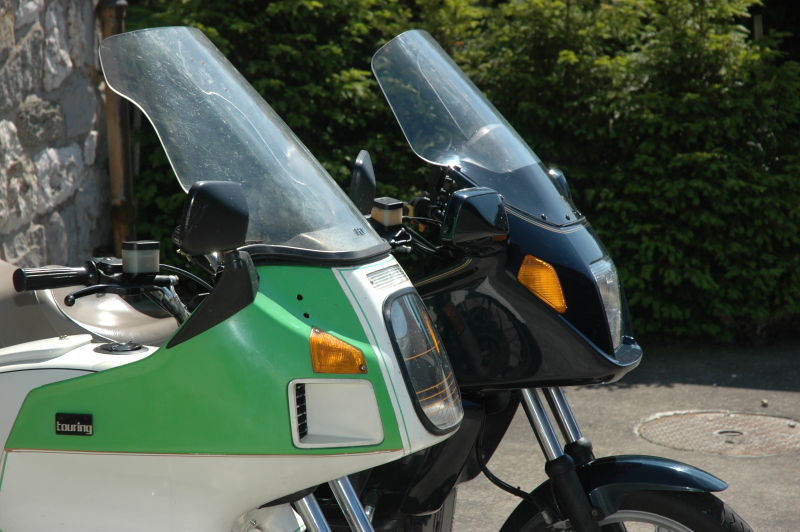
A distinct feature of the early RT fairings, be it the airhead or the K, is the weather and wind protection. The upper part of the K fairing is even better than that of the R, since there are almost no turbulences behind the fairing. On the downside, the protection for the rider's feet is less perfect on the K.
As far as I know, three different versions of the windshield were available from BMW:
Similar to the airhead RT, the 565-mm screen also causes quite some wind noise. The big difference is that this is "just" noise - no turbulences, no buffeting. But ... the noise is deafening!
My workaround is the same as on the airhead RT: Use the Fanta Spoiler, which works like a charm. Now I ride with an open visor most of the time; conversation with a passenger at non-highway speeds is easily possible without shouting. The only time when I notice some buffeting is when I'm following a larger vehicle at highway speeds.

The LT was originally equipped with the BMW "comfort seat". While it is indeed very comfortable, it forces the rider into a fixed position: with my 190 cm I could not move a lot. Long rides put strain on my legs.
I solved this problem by acquiring a stock seat from another K100. The seating position is now much more relaxed (especially for my legs) and since I can move, my preferred passenger ;-) also reports a better contact to the rider.
The only thing that remained was to change the color of the backrest on the topcase - simply to have its color matching that of the seat. Done by swapping with a colleague from the flyingbrick.de forum.


I got my K100LT in 2010-06, barely 20 years and 1 month young, with 37000 km on the counter.
The BMW workshop manual for the K100 series is available as a regular, official part from BMW. The booklet carries part number 01509798790 (german version); for the english version, the part number is 01519798791.